

Ever wondered about those cats with the wonderfully wavy, curly coats? You might be thinking of either the Devon Rex or the Cornish Rex, and honestly, they’re both pretty special. While they share that unique curly look, these two breeds have their own distinct histories and quirks. If you’re curious about what makes each of them tick, from their origins to their personalities, you’ve come to the right place. We’re going to break down the differences and similarities between the devon rex cornish rex so you can get a better idea of what makes them so fascinating.
Key Takeaways
- The Cornish Rex originated in Cornwall, England, in the 1950s from a spontaneous genetic mutation, while the Devon Rex emerged a few years later in Devonshire, England, from a separate mutation.
- Both breeds are known for their distinctive curly or wavy coats, which are caused by different genetic factors, and they have minimal shedding.
- Rex cats are generally social, intelligent, and very playful, often retaining kitten-like behaviour throughout their lives.
- Due to their sparse coats, both Devon Rex and Cornish Rex cats are sensitive to cold and actively seek warm places.
- While grooming is low-maintenance, potential owners should be aware of specific health considerations and the need for a stimulating, warm environment for these unique felines.
Unravelling The Origins Of The Devon Rex And Cornish Rex
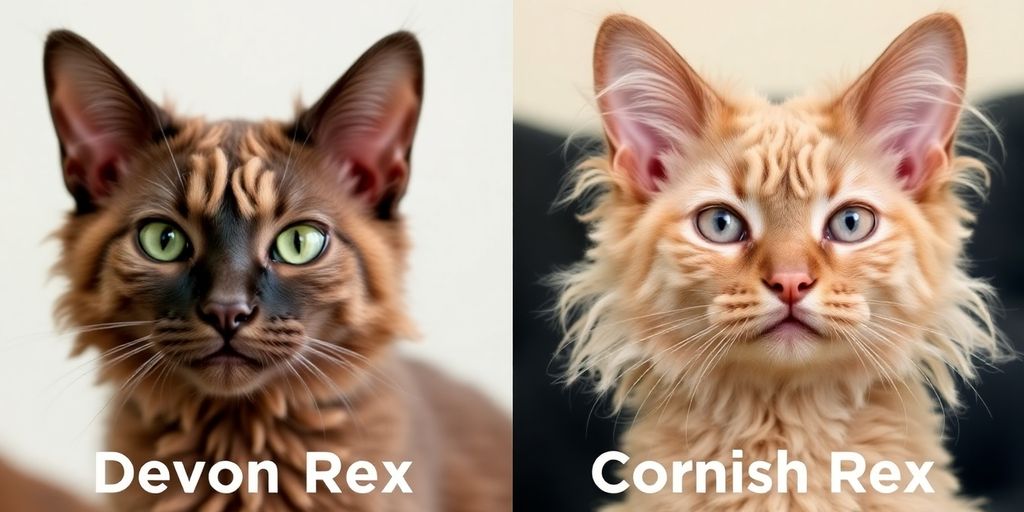
Right then, let’s get stuck into where these wonderfully curly cats actually came from. It’s a bit of a fascinating story, really, involving a bit of luck and a few unexpected twists. You see, both the Devon Rex and the Cornish Rex have these amazing curly coats, but they actually arose independently. It’s not like one came from the other, which is pretty wild when you think about it.
The Cornish Rex’s Humble Beginnings
So, the Cornish Rex story kicks off in Cornwall, England, way back in 1950. It all started in a rather ordinary litter of barn cats. Among them was a kitten named Kallibunker, who looked quite different from his siblings. He had this incredibly fine, short coat that was all wavy and rippled, a bit like a poodle or, well, a rex rabbit. This unique look was down to a natural genetic mutation. The folks who found him thought he was rather special and decided to breed him back to his mum to try and keep that curly trait going. And that’s how the Cornish Rex line began, with this one unusual kitten.
The Devon Rex’s Emergence
Fast forward a bit to 1959, and over in Devonshire, England, another litter of kittens popped up with a similar curly coat. Now, these kittens were from a different set of parents and a different location, but they shared that same distinctive, wavy fur. This was the start of the Devon Rex breed. It’s quite something that this curly coat gene popped up twice, completely separately, in different parts of the country.
A Tale Of Two Rex Breeds
It’s easy to get them mixed up, what with the similar names and the curly coats, but they’re definitely not the same breed. They have different genetic backgrounds for their curls, and when you look closely, there are physical differences too. Think of it like two different families developing a similar fashion sense independently – they both like curly hair, but they got there by their own routes. It’s a neat bit of natural history, really. If you’re thinking about getting one of these unique cats, it’s worth knowing their individual stories, which helps you appreciate what makes each one special. For instance, understanding the history of breeds like the Oriental Tabby can give you a broader appreciation for feline diversity.
These cats, with their distinctive looks and playful personalities, have a history that’s as captivating as their appearance. It’s a testament to the quirks of nature that such unique traits can emerge independently, creating two beloved breeds from separate origins.
It’s pretty amazing how nature works, isn’t it? Two distinct breeds, both with that signature wave, appearing in different corners of England. It really highlights the wonderful variety you can find in the cat world.
The Distinctive Curly Coats Of The Rex Breeds
Right then, let’s talk about what makes these Rex cats so utterly unique – their fabulous curly coats! It’s not just a bit of a wave, oh no. This is a proper genetic quirk that gives them that wonderfully soft, almost velvety feel. Think of it like a permanent, stylish perm, but for cats.
What Makes Their Coats So Special?
So, what’s the deal with the curls? It all comes down to a gene mutation. Unlike most cats who have three types of hair – a coarse outer coat, a middle awn coat, and a fine downy undercoat – Rex cats are missing the coarse guard hairs. What they’re left with is primarily the soft, wavy undercoat. This is what gives them that distinctive, crimped look. It’s pretty fascinating, really, how a little genetic hiccup can create something so visually striking.
More Than Just A Wave
It’s not just about the look, though. This lack of guard hairs means their coats are incredibly soft to the touch, often described as feeling like velvet or even silk. And because they don’t have that protective outer layer, their skin can be a bit more sensitive to things like sunburn and extreme temperatures. You’ll often find them seeking out warm spots, like sunbeams or snuggling up close to you, to stay cosy.
Grooming Your Curly Companion
Now, you might think a curly coat means loads of grooming, but you’d be surprised! Rex cats are actually pretty low-maintenance in this department. Their short, curly fur doesn’t shed much, so you won’t be finding tumbleweeds of cat hair all over your house. A gentle brush once a week with a soft brush is usually enough to keep their coat in good condition and remove any loose hairs. It’s more about maintaining the softness than dealing with tangles. Their ears, which are often quite large and prominent, might need a gentle wipe now and then to keep them clean, but generally, they’re pretty self-sufficient.
Remember, while their coats are unique, they still need care. Think of it as a gentle touch rather than a vigorous scrub. Their skin is delicate, so avoid harsh chemicals or excessive bathing.
Here’s a quick rundown of what to expect:
- Texture: Soft, wavy, and often described as velvety.
- Shedding: Minimal, thanks to the lack of guard hairs.
- Grooming Needs: Weekly gentle brushing, occasional ear cleaning.
- Sensitivity: Their skin can be more prone to sunburn and cold.
Personality Pointers: What To Expect From Your Rex
Right then, let’s chat about what makes these curly cats tick when it comes to their personalities. Forget aloof and independent; both the Devon and Cornish Rex breeds are more like furry, four-legged toddlers who never quite grow up. They’re incredibly social creatures, often described as being ‘dog-like’ in their need for companionship and interaction. If you’re after a cat that’s happy to just nap in a sunbeam all day, these might not be the ones for you. They want to be involved in everything you do.
Social Butterflies And Intelligent Explorers
These cats are proper social butterflies. They genuinely love being around people and often form strong bonds with their families. You’ll find them following you from room to room, keen to see what you’re up to, and they’re not shy about demanding attention. Their intelligence is also a big part of their charm. They’re curious, quick learners, and can even be trained to do tricks or walk on a lead, which is pretty unusual for a cat! They love to explore their surroundings, poking their noses into every nook and cranny.
Playful Personalities That Last
One of the most endearing traits of Rex cats is their enduring playfulness. Unlike some breeds that might calm down significantly after kittenhood, Rex cats tend to retain that kitten-like zest for life well into their adult years. Expect a lot of chasing, pouncing, and general silliness. They have a good amount of energy, so providing them with plenty of toys and opportunities for interactive play is a must. Think feather wands, crinkle balls, and maybe even a laser pointer (used responsibly, of course!).
Seeking Warmth And Affection
Because of their unique, sparse coats, Rex cats can feel the cold more than other breeds. This means they’re often on the lookout for a warm spot. Whether it’s a sunny patch on the floor, a cosy blanket, or, more likely, your lap, they’ll find it. They absolutely adore a good cuddle and will often seek out physical contact with their favourite humans. Don’t be surprised if your Rex cat decides your shoulders are the perfect perch or your chest is the ideal place for a nap. They really do crave that closeness and warmth.
These cats are not just pets; they’re more like furry little companions who want to be part of the family’s daily life. Their playful antics and affectionate nature mean you’ll never be bored, but be prepared for a cat that needs attention and interaction to be truly happy.
Caring For Your Curly-Coated Felines
Ideal Living Conditions For Rex Cats
These cats, with their unique coats, aren’t built for the great outdoors. They really do best as indoor pets. Their fine fur doesn’t offer much protection against the elements, meaning they can get chilly quite easily, especially the Cornish Rex. Think of them as needing a bit of a cosy environment, much like a favourite jumper. Keep them away from draughty windows and definitely out of direct, harsh sunlight for too long, as their skin can be sensitive. A warm spot near a radiator or a sunny windowsill (with supervision!) is usually a big hit. They’re also quite active and curious, so providing them with plenty of vertical space – think cat trees and shelves – will keep them entertained and out of mischief.
Dietary Needs For Active Breeds
Both Devon and Cornish Rex cats are known for being energetic and, let’s be honest, sometimes a bit greedy! They need a good quality diet that’s high in protein to keep their lean bodies fuelled. Look for cat food that’s specifically formulated for active cats, or one that lists a good meat source as the first ingredient. Because they can be prone to overeating, it’s a good idea to stick to set meal times rather than leaving food out all day. This helps manage their weight and prevents them from getting too tubby. Always make sure they have access to fresh, clean water – dehydration is never a good look for anyone, feline or otherwise!
Specific Health Considerations
While generally a healthy bunch, Rex cats can sometimes have a few specific health quirks to watch out for. Some Cornish Rex cats, for instance, can be prone to a heart condition called hypertrophic cardiomyopathy (HCM) and issues with their kneecaps (patellar luxation). Devons can sometimes have their own genetic predispositions, though they are generally robust. Because their coats are so sparse, they can be more susceptible to skin issues if they get too much sun or if their skin gets irritated. Regular vet check-ups are a good way to catch any potential problems early. It’s also worth noting that their lack of dense fur means they feel the cold more acutely, so keeping them warm is important for their comfort and well-being.
It’s always a good idea to have a chat with your vet about the best diet and any specific health concerns for your particular Rex cat. They’re the experts, after all!
Devon Rex vs. Cornish Rex: Key Differences
Spotting The Subtle Variations
So, you’ve got a soft spot for those wonderfully wavy cats, but which Rex is right for you? While both the Devon Rex and Cornish Rex share that signature curly coat and a penchant for mischief, there are some neat little differences to spot. Think of it like comparing two types of curly fries – both delicious, but with their own unique texture.
One of the most noticeable distinctions is their head shape. Devon Rexes tend to have a more pixie-like face with large ears set low on their head, giving them a perpetually surprised look. Cornish Rex cats, on the other hand, often have a more refined, wedge-shaped head with ears set higher up. It’s subtle, but it’s there!
Understanding Their Unique Traits
When it comes to their coats, both breeds are known for being minimal shedders, which is a big plus for many. However, the texture can vary. Cornish Rex fur is often described as finer and silkier, almost like velvet. Devon Rex coats can be a bit more varied, sometimes a little coarser or even having patches that are almost bald, though they still retain that lovely wave. It’s not just a wave; it’s a whole different feel!
Here’s a quick rundown:
- Coat Texture: Cornish Rex is typically finer and silkier; Devon Rex can be a bit more varied, sometimes softer, sometimes a bit more robust.
- Head Shape: Devon Rex often has a pixie-like face with large, low-set ears; Cornish Rex tends to have a more wedge-shaped head with higher-set ears.
- Body Build: Both are slender and athletic, but Cornish Rexes can sometimes appear a touch more elegant or ‘whippet-like’.
Both breeds are incredibly social and love to be involved in everything you do. They’re not the sort of cats you can leave alone for long periods; they really thrive on companionship and will often follow you from room to room, just wanting to be part of the action. They’re also super intelligent and can even be trained to do tricks!
Choosing Your Perfect Rex Companion
Ultimately, the choice between a Devon Rex and a Cornish Rex often comes down to personal preference. Do you prefer that elfin charm of the Devon, or the more classic, elegant lines of the Cornish? Both will bring a unique brand of playful energy and affectionate cuddles into your home. If you’re looking for a cat that’s a bit of a character and loves to be the centre of attention, either of these curly-coated wonders will fit the bill. Just remember, their lack of dense fur means they do feel the cold, so expect them to be seeking out the warmest spots in the house – often on your lap!
If you’re keen on learning more about specific breed characteristics, checking out resources on feline breed differences can be really helpful.
So, Which Curly Cat is for You?
Right then, after all that chat about those wonderfully wavy kitties, it’s pretty clear that both the Devon Rex and the Cornish Rex are absolute characters. They’re not just pretty faces with their unique coats, are they? They’re proper little companions, full of beans and always up for a bit of fun. Whether you’re leaning towards the slightly more mischievous Devon or the elegant Cornish, you’re in for a treat. Just remember, these aren’t your typical aloof cats; they want to be involved in everything you do, and they do get a bit chilly, so a warm lap is always a bonus! Honestly, either way, you’re getting a loyal, playful friend who’ll keep you entertained for years to come. Pretty neat, eh?
Frequently Asked Questions
What makes the coats of Devon Rex and Cornish Rex cats so special?
Both the Devon Rex and Cornish Rex have unique coats that don’t have the usual three hair types found in most cats. Instead, their coats are made up of soft, wavy down hair, which gives them a crimped or rippled look. This means they have less fur than other cats, making their coats feel very soft to the touch.
Are these curly-coated cats high-maintenance when it comes to grooming?
Actually, they are quite low-maintenance! Their short, wavy fur doesn’t shed much, so they don’t need frequent brushing. A gentle wipe with a damp cloth now and then is usually enough. Their big ears might need a quick clean occasionally, but overall, they’re pretty easy to keep tidy.
What is the personality of a Devon Rex or Cornish Rex like?
These cats are known for being super friendly, really smart, and very playful. They love to be involved in everything you do and are often described as being like little clowns or elves. They enjoy being around people and can be quite cuddly, always looking for a warm spot, like your lap!
Do Rex cats get along well with other pets or children?
Yes, they generally do! Because they are so social and love company, they often get along well with other cats, dogs, and children. They have a gentle nature and enjoy being part of a busy, lively household. Just make sure introductions are done slowly and carefully.
Are there any special health concerns I should know about for these breeds?
Both breeds are usually healthy, but they can be a bit sensitive to cold weather because they have less fur for warmth. They might also be prone to certain genetic conditions, like heart or joint issues, though this isn’t guaranteed. Regular visits to the vet are a good idea to keep an eye on their health.
Why do Rex cats always seem to be looking for warm places?
It’s because their special coats offer less insulation than a full coat of fur. This means they can get chilly more easily. So, they naturally seek out warm spots to keep comfortable, whether that’s a sunny windowsill, a cosy blanket, or snuggled up close to you.
